
Building software that actually works for your business - not just for today, but three years from now - is harder than most companies expect. Off-the-shelf tools have limits, and those limits show up at the worst possible time: when you're scaling, when a client needs a custom workflow, or when a security gap turns into a breach.
That's where software development services make a real difference. Instead of bending your operations around a generic product, you get a system built around how your business actually runs. In this article, we'll walk through exactly how custom software development supports growth — from the first planning session to long-term post-launch maintenance.
Table of Contents
Custom Software Development Approach
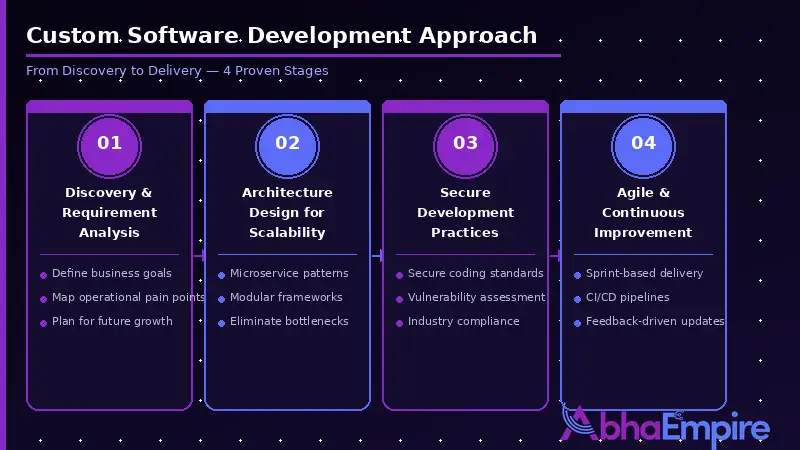
Every software project we take on starts with a simple question: what problem are you actually trying to solve? From there, the development process follows a structured path - one designed to reduce surprises and deliver something that holds up under real-world usage.
1. Discovery and Requirement Analysis
Before a single line of code is written, we spend time understanding your business - your workflows, your pain points, and where you want to be in two to three years. Discovery sessions involve your key stakeholders and our technical team working together to map out requirements, identify edge cases, and agree on scope.
This phase matters more than most clients expect. Many failed software projects can be traced back to skipped or rushed discovery - features get built that nobody needed, and critical ones get missed entirely. A clear, documented requirement set is the foundation everything else rests on.
2. Architecture Design for Scalability
Once requirements are defined, we design the system architecture. For most modern applications, this means choosing between a monolithic structure (faster to build, suitable for smaller apps) and a microservices architecture (more complex upfront, but easier to scale independently). The right choice depends on your expected growth rate, team size, and how often different parts of the system will need to change.
Good architecture decisions made early prevent costly rewrites later. A well-designed system lets you add a new feature or double your user base without tearing down what already works.
3. Secure Development Practices
Security isn't something you bolt on at the end - it's built into every stage of development. We follow secure coding practices that include input validation, proper authentication handling, encrypted data storage, and regular dependency audits. Our teams follow OWASP guidelines as a baseline and adapt them to the specific compliance requirements of each industry we work with.
4. Agile Development and Continuous Improvement
We build in short, focused cycles rather than spending months in development before showing you anything. This means you see working software early, give feedback while there's still time to act on it, and end up with a product that reflects how the business actually works - not how it worked six months ago when requirements were written.
Development Methodology (Agile/Scrum)
Agile is often described as a philosophy, but in practice it comes down to one thing: shorter feedback loops. Instead of a waterfall approach where requirements are locked in upfront and the client sees the product at the end, Agile breaks work into two-to-four-week sprints. Each sprint ends with a working, reviewable piece of the product.
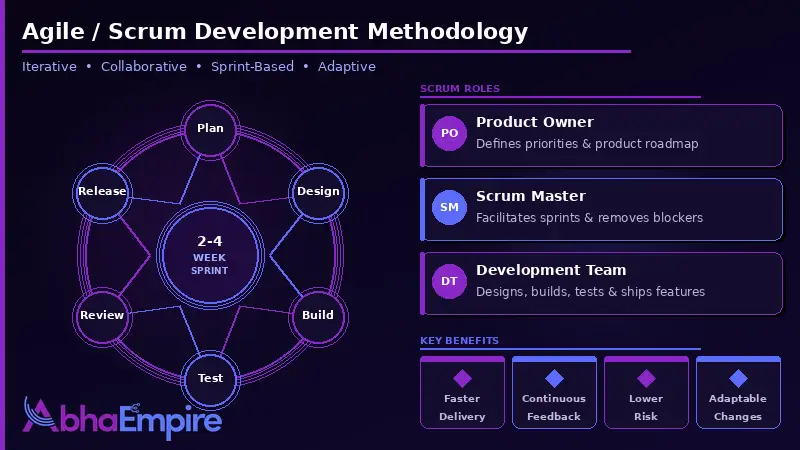
Within the Scrum framework, three roles keep things moving:
- Product Owner - represents the business, owns the backlog, and decides what gets prioritised
- Scrum Master - keeps the process running smoothly and removes blockers for the team
- Development Team - builds, tests, and ships working software each sprint
Daily standups keep everyone aligned without consuming half the day in meetings. Sprint reviews let stakeholders see real progress. Retrospectives give the team a structured way to improve how they work together.
The practical benefits of this approach are significant:
- Issues are caught early, when fixing them is cheap
- Requirements that change mid-project (and they always do) can be accommodated without derailing the whole timeline
- Clients are never surprised - they're part of the process throughout
- The product at launch is one that's been reviewed and validated, not just handed over
Technology Stack & Architecture
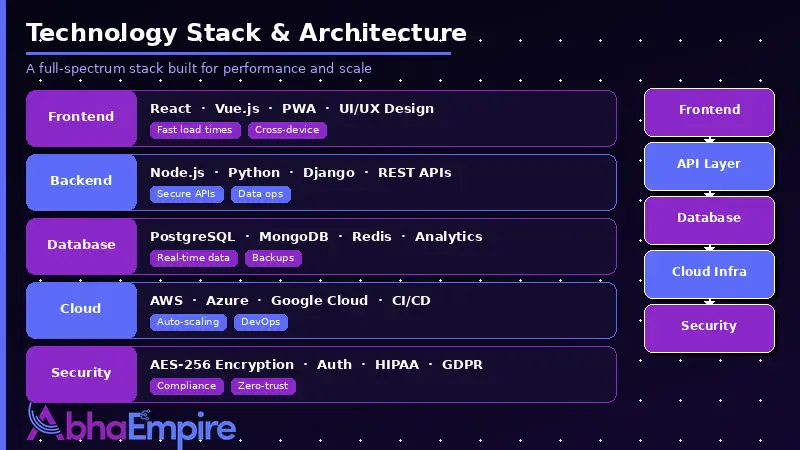
The technology you build on shapes how well your software performs, how much it costs to maintain, and how easily it can grow. We don't push a single stack for every project - we match the tools to the problem.
1. Modern Frontend Technologies
For user-facing interfaces, we work primarily with React and Vue.js. Both frameworks deliver fast, responsive UIs that work consistently across devices. React suits larger, more complex applications with lots of dynamic content; Vue is often faster to build with for mid-size projects where simplicity matters. Either way, the result is an interface that loads quickly and doesn't frustrate users.
2. Robust Backend Development
On the backend, Node.js works well for real-time applications and high-concurrency scenarios, while Python is a strong choice for data-heavy systems, automation, and anything involving machine learning integration. Java and .NET remain strong options for enterprise environments with existing infrastructure. We design APIs that are well-documented, versioned, and built to handle the load your application will face - not just at launch, but at 10x your current scale.
Database design is handled carefully too. The right choice between SQL and NoSQL depends on your data structure and query patterns - and getting it wrong creates performance problems that are painful to fix later. Learn more about our approach to database management.
3. Cloud Infrastructure and DevOps
We deploy on AWS, Azure, and Google Cloud depending on your existing setup and preferences. Cloud infrastructure gives you flexibility that on-premise hosting simply can't match - you scale up during peak periods and scale back when you don't need the capacity. CI/CD pipelines mean updates get tested and deployed automatically, reducing human error and letting your team ship faster without the anxiety of manual deployments.
4. Database and Data Management
Beyond choosing the right database type, we build in proper indexing strategies, caching layers, and backup procedures from day one. Real-time analytics capabilities are integrated where needed, giving your team visibility into how the system performs and how users interact with it.
5. Security and Compliance Architecture
Encryption at rest and in transit, role-based access control, audit logging, and compliance with relevant standards (GDPR, HIPAA, PCI-DSS depending on your sector) are built into the architecture - not treated as afterthoughts.
Web Applications & Enterprise Software
Web applications and enterprise platforms serve very different purposes, but both benefit enormously from being built around how your business actually operates rather than forcing your team to adapt to someone else's product.
Modern web applications run in the browser - no installation required, accessible from any device. Depending on your needs, this might be a single-page application (SPA) for a fast, interactive experience, or a progressive web app (PWA) that works offline and can be installed like a native app on mobile devices.
Enterprise software goes deeper, handling the complex workflows that run the business day to day. Common examples include:
- Customer Relationship Management (CRM)
- Enterprise Resource Planning (ERP)
- Supply Chain Management
- Human Resource Management systems
The advantage of custom enterprise software over off-the-shelf solutions is control. You're not paying for features you'll never use, and you're not missing features you urgently need. Repetitive manual tasks get automated, data sits in one place instead of scattered across spreadsheets and disconnected tools, and departments that rarely talked to each other suddenly have a shared view of the business.
Modern enterprise solutions we build typically include real-time analytics dashboards, granular role-based access control, and cloud-based deployment managed through DevOps pipelines that keep downtime close to zero during updates.
API Design & Integration
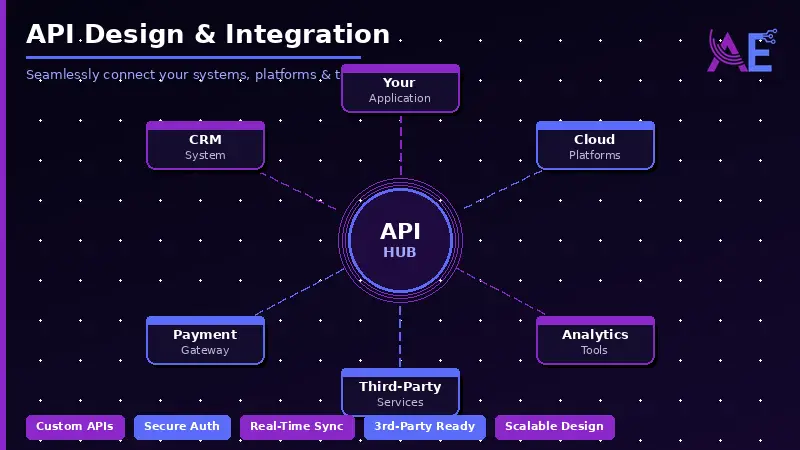
Most businesses today run on a mix of systems - a CRM here, a payment gateway there, a third-party logistics platform, an analytics tool. APIs are what make these systems talk to each other. When APIs are well-designed, data flows cleanly, processes run automatically, and teams stop re-entering the same information in five different places.
1. Building Strong Digital Foundations
We design APIs with longevity in mind. That means following API documentation standards, versioning from day one, and building in enough flexibility that new integrations don't require rewriting what already works. A poorly structured API becomes technical debt that slows down every future development effort.
2. Custom API Development
RESTful APIs are the standard for most web and mobile integrations - they're lightweight, well-understood, and easy to consume across different platforms. For more complex enterprise systems where different services need to communicate independently and scale separately, we design around microservices-based approaches that keep each component decoupled and easier to maintain.
3. Secure Data Exchange
Every API we build treats security as a requirement, not an option. We implement OAuth 2.0 and JWT-based authentication, enforce HTTPS across all endpoints, apply rate limiting to prevent abuse, and validate all inputs server-side. For industries handling sensitive data - healthcare, finance, legal - we add additional controls specific to the compliance requirements of that sector.
4. Third-Party Integration
We regularly integrate with payment gateways like Razorpay, Stripe, and PayU; CRM platforms like Salesforce and HubSpot; logistics APIs; communication tools like WhatsApp Business API and Twilio; and cloud storage services. Each integration is tested thoroughly in staging before it goes anywhere near production.
5. Performance Optimization and Maintenance
APIs degrade over time if nobody's watching them. We set up monitoring from day one - tracking response times, error rates, and usage patterns so problems are caught before users notice them. Regular performance reviews and proactive updates keep integrations running cleanly as the systems on both ends evolve.
Security & Code Quality
Two things that are easy to deprioritise under deadline pressure - and expensive to fix after the fact. We treat security and code quality as non-negotiable throughout the development process, not something to address in a final review before launch.
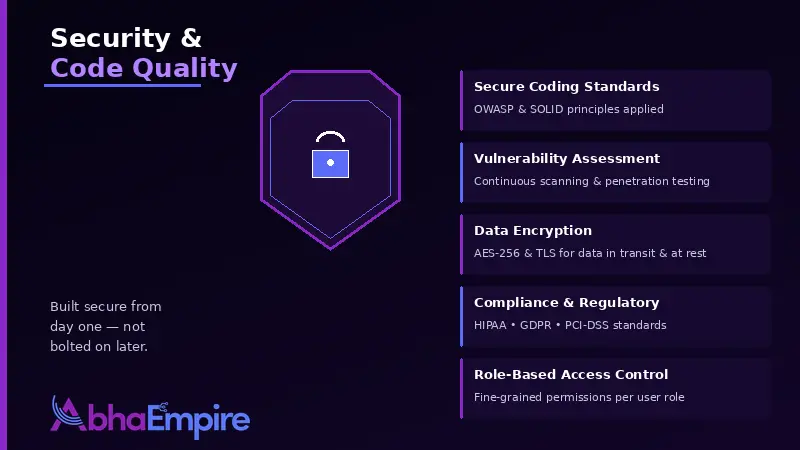
1. Secure Coding Standards
Our developers follow OWASP Top 10 guidelines as a baseline - covering injection attacks, broken authentication, sensitive data exposure, and other common vulnerabilities. Security reviews happen at the code level, not just at the infrastructure level. We use static analysis tools to catch issues automatically during the development process, before they ever reach a review or testing stage.
2. Code Reviews and Peer Testing
No code reaches production without being reviewed by another developer. Code reviews catch logic errors, spot potential security gaps, and ensure consistency with the project's architecture decisions. Over time, this practice also raises the overall quality of the team's work - good habits spread through the codebase.
3. Automated Testing
We write unit tests, integration tests, and end-to-end tests as part of development - not as an afterthought. Automated test coverage means that when something changes in one part of the system, you immediately know if it broke something else. This is what makes continuous deployment safe rather than stressful.
4. Vulnerability Assessments
Before any major release and on a regular schedule after launch, we run vulnerability assessments to identify security weaknesses in the application. For projects in regulated industries, we also support third-party penetration testing and provide the documentation your compliance team needs.
5. Maintainable Code Architecture
Code that works but nobody can understand is a liability. We apply SOLID principles, keep functions focused and well-named, and document architecture decisions so that any developer - including ones who join the project later - can work effectively. Technical debt is tracked and addressed, not allowed to accumulate until it becomes a crisis.
Scalability & Performance
A system that works well with 500 users needs to be designed differently than one that needs to handle 500,000. Scalability doesn't happen automatically - it's a result of deliberate architecture choices, infrastructure decisions, and performance testing done before load becomes a problem.
Horizontal scaling - adding more server instances rather than just upgrading hardware - is the standard approach for modern cloud-hosted applications. Cloud-native architecture makes this practical, with auto-scaling groups that spin up additional capacity when demand spikes and scale back down when things quiet.
Performance optimisation techniques we use across projects include:
- Caching frequently requested data at the application and database layer
- Load balancing across multiple server instances
- Database query optimisation and proper indexing
- Content delivery networks (CDNs) for static assets
- Asynchronous processing for tasks that don't need to happen in real time
We run load testing and stress testing before launch to establish baselines and confirm that the system handles your expected peak traffic with room to spare. After launch, monitoring tools give continuous visibility into performance - so slowdowns are caught and addressed before users start complaining.
The result is a system that stays fast and reliable as your business grows, with resource costs that scale proportionally rather than exponentially.
Post-Launch Support
Launch day is not the finish line. In many ways, it's where the real work begins. Software needs ongoing care - bugs get discovered in production that testing didn't catch, user behaviour reveals friction points that weren't obvious in staging, and the business itself changes in ways that require the product to change with it.
Our post-launch support covers the practical things that keep a live system running reliably. Bug fixes are triaged by severity and addressed on timelines that match their impact. Security patches are applied promptly when vulnerabilities are discovered in dependencies or infrastructure components. Performance is monitored continuously, with alerts set up for anything that falls outside normal parameters.
Beyond maintenance, we track how users interact with the system through analytics and session data. This informs a prioritised improvement roadmap - changes that will have the most impact get worked on first, rather than a backlog that grows faster than it shrinks.
Post-launch services typically include:
- Bug fixes and incident response
- Security patch management
- Performance monitoring and optimisation
- Backup and disaster recovery planning
- Feature development based on user feedback and business needs
- Continuous integration and deployment (CI/CD) pipeline maintenance
The goal is simple: make sure the software you invested in keeps delivering value long after the initial build is complete.
Industries We Serve
Different industries have very different requirements - different compliance obligations, different user expectations, different technical constraints. We build specifically for the sector we're working in, not just adapt a generic solution.
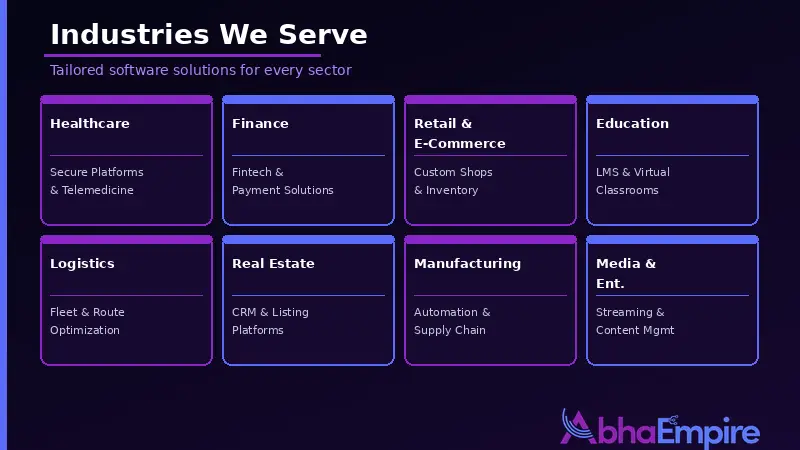
1. Healthcare
We develop healthcare platforms that handle the dual challenge of being genuinely useful to clinicians and fully compliant with data protection requirements. This includes patient management systems, telemedicine platforms, and clinical workflow tools - all built with HIPAA/DPDP compliance, role-based access, and audit trails in place from the start.
2. Finance and Banking
Financial software demands precision, security, and regulatory compliance in equal measure. Our fintech development work covers payment platforms, lending systems, fraud detection tools, and banking portals - all built with end-to-end encryption, real-time transaction processing, and PCI-DSS compliance where applicable.
3. Retail and E-commerce
Retail software needs to handle inventory, orders, customers, and payments without dropping the ball at peak load. We build custom retail and e-commerce platforms that integrate with existing supply chains, support personalised customer experiences, and scale reliably during seasonal spikes.
4. Education and E-Learning
Learning platforms need to be accessible, engaging, and reliable for large concurrent user bases. Our EdTech solutions include custom LMS platforms, virtual classrooms, and assessment tools - built to handle thousands of simultaneous learners while keeping content secure and performance consistent.
5. Manufacturing
Manufacturing operations benefit from software that connects the shop floor to management. We build production monitoring systems, ERP integrations, and supply chain management tools that give plant managers and executives a real-time view of operations and help identify inefficiencies before they become costly.
6. Logistics and Transportation
Fleet management, route optimisation, and shipment tracking are complex problems that the right software can simplify significantly. We build transport and logistics platforms that provide real-time visibility across the delivery chain, reduce operational overhead, and improve on-time performance.
7. Real Estate
Property management, tenant portals, digital listing platforms, and CRM systems built for real estate businesses need to handle complex transaction workflows and large amounts of media content. We build platforms that make those processes faster and less error-prone for agents, managers, and buyers alike.
8. Media and Entertainment
Content delivery at scale requires robust infrastructure and smart caching. Our media and entertainment software covers streaming platforms, content management systems, and audience analytics tools - built to handle high traffic loads while keeping latency low and uptime high.
Conclusion
Good software doesn't happen by accident. It's the result of clear requirements, disciplined development, and ongoing investment in quality - both during the build and after launch. The businesses that get the most from their technology are the ones that treat software as a long-term asset, not a one-time project.
If you're dealing with systems that have outgrown their original design, manual processes that should have been automated years ago, or a product idea that you haven't yet been able to bring to life - that's where AbhaEmpire comes in. We'd rather have an honest conversation about what you need than oversell a solution that doesn't fit.
Get in touch to discuss your project and we'll give you a straight assessment of what it would take to build it right.
FAQs
1. What are Software Development Services?
-Software development services include designing, building, testing, and maintaining custom applications tailored to business needs. The services enable companies to optimize their operations while increasing productivity and delivering better results to their clients.
2. How do Software Development Services Support Scalability?
+Scalable software requires a flexible architectural design. The system enables businesses to manage higher user volumes and increased transaction rates while maintaining operational efficiency. The combination of cloud-based systems and modular architecture simplifies the process of future expansion.
3. Why is Security Important in Software Development?
+Security measures safeguard sensitive information against cyber attacks. The combination of secure coding methods and consistent updates along with industry standard compliance protects business data from potential threats.
4. Can Custom Software Improve Business Growth?
+Yes. Custom software solutions provide businesses with automated processes that deliver valuable insights that help achieve specific goals and establish competitive advantages.
5. How Long Does Software Development Take?
+The development timeline needs assessment of both project difficulty and required project features and system integration needs. Small projects may take weeks, while enterprise solutions can take several months.
6. Is Ongoing Maintenance Necessary?
+Yes. Mandatory maintenance work exists because software needs continuous updates together with performance assessments and security updates which protect its efficiency and security while supporting changing business requirements.